We arrived in Salta shortly after noon, and because I was anxious to do at least some sightseeing before our departure the following day, I was up for letting a taxi driver bring us to our accommodations even though they appeared to be less than a mile away and hence should have been easily walkable, assuming we could find our way readily. We were at Bloomers Bed and Brunch, which was easily the nicest place we stayed during our entire trip (with one exception -- no wi-fi in our room!). The room and even the bathroom had room in which to spread out, and both were nicely decorated. Bloomers' owner was very helpful with ideas about things to do, and of course as one would expect at a B&B, there was a homemade breakfast that was easily the best we had had in Argentina.
 |
| Bathroom in our room at Bloomers B&B |
 |
| Our room at Bloomers B&B |
We went out to walk around Salta; it is a highly walkable city with most of the main attractions within a several-block area around the main square, the Plaza el 9 de Julio. We headed first to the main square to find tourist information and look at the pretty buildings, such as the Cathedral below.
 |
| Salta's Cathedral seen from the main square |
 |
| The Salta cathedral's blue dome |
The building right next to the cathedral was an ugly modern thing, but its glass wall produced this interesting photo, very much in the style of our friend Julie Miller:
 |
| Dome of Salta Cathedral reflected in building next door |
We had lunch at El Solar del Convento, a very fancy restaurant; I had a grilled steak and Nancy had grilled vegetables which were pretty good.
 |
| Lomo Walesca at el Solar del Convento in Salta |
 |
| Grilled vegetables at el Solar del Convento in Salta |
We continued our walk around town, looking for example at the Basílica Menor y Convento de San Francisco
 |
| Basílica Menor y Convento de San Francisco in Salta |
before heading into a fascinating museum, the Museum of High Altitude Archeology (Museo de Arqueología de Alta Montaña) which shows the results of an archeological mission back in 1999, when the mummies of three Inka children were found where they had been sacrificed near the summit of Volcan Llullailiaco, a peak on the Argentine/Chilean border some 20,000 feet above sea level. The removal of the bodies occasioned some controversy; the exhibit sidestepped those issues while detailing the culture that gave rise to the sacrifice and providing videos showing the expedition and interviewing participants. Many artifacts were in display and one child at a time is shown in a special light-and-temperature-controlled case while the other two are kept in a vault.
No photos were allowed and in any event the mummy was so ghoulish that I am not sure I would have done so in any event.
After we left the museum, we were able to enter the highly decorated cathedral
 |
| Interior of Salta's cathedral |
 |
| Interior of Salta's Cathedral |
++ |
| Interior of Salta's Cathedral |
We also walked back to the San Francisco church; note the curtains carved in stone:
 |
| Basílica Menor y Convento de San Francisco in Salta: detail of exterior |
 |
| Dome in the Basilica San Francisco |
 |
| Interior of the Basilica San Francisco |
Then we walked up to Calle Balcarce to see the Sunday-only artisans' market. There were a number of interesting things to buy but, again, most of the best were not transportable by airplane. On the way back, we passed a restaurant named Pasionaria that offers tango lessons --- every day except Sunday. But it had a heavily occupied outdoor eating area and the food looked good, so we noted it as a possibility for dinner. We headed back to the area of the main plaza and took a look at the free Museo de Arte Contemporaneo, which was showing work by local artist Nicolas Cornejo. We liked some of the artistic furniture on display:
 |
| From a show at Salta's Museo de Arte Contemporaneo |
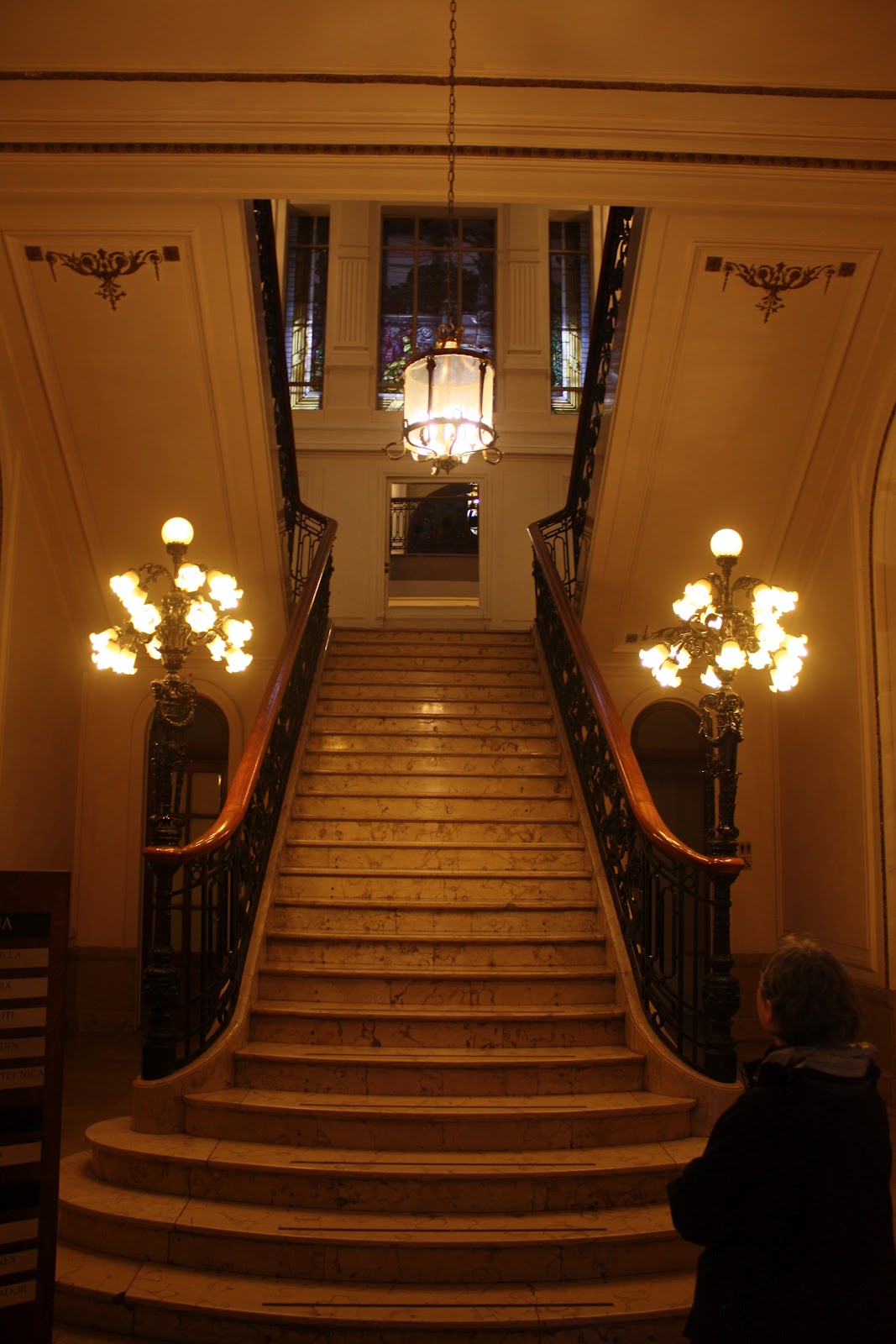
As we came out, we saw Tom eating in the Cafe Van Gogh and stopped to chat for a while, but although we had in mind to have a snack before a late dinner, we wanted to eat under an awning, so we crossed the plaza and sat down for a plate of empanadas, the snack for which Salta is particularly noted. (And they wre very good indeed!) We passed an interesting building called the Centro Cultura America was built in the early 1900's for the Jesuits; the art being shown inside was of no interest whatsoever, but again admission was free so we took advantage of the opportunity to admire the building from inside as well as outside.
 |
| Centro Cultura America |
 |
| Inside the Centro Cultura America |
 |
| Inside the Centro Cultura America |
We had a late night in mind, so we headed back to our hotel for a nap, then went to dinner at Pasionaria. We got the mixed grill "para 2-3 personas"; they must have had two or three huge appetites in mind, because we couldn't eat half of what was served, and took the rest to have for lunch the following day.
Next we headed out to see a peña -- the folkloric performances for which Salta is particularly well-known. Many peñas are essentially stage shows, but at the suggestion of our host at Bloomers, we opted for a different kind of peña, held as La Casona del Molina, an old house in an otherwise wholly residential area far from the center. The house had several different rooms, with one or more musicians in each room, basically hanging out with the audience and singing with them. In the room where we found a seat was a musician with a concertina, which he played while singing with considerable gusto; the folks at the table where he was sitting offered him food and drink, and on many of the songs, they sang along with him. We did not know any of the songs, of course. One of the middle-aged women at the table sung a number of solos in a very young-girl-like soprano, consulting a large folder of song sheets for the words. We couldn't tell whether she was a musician or a member of the party at the table where she was sitting (they looked to be about her age).
I don't know if there was supposed to be admission fee, but nobody asked us to pay. We had been told that the festivities would begin no sooner that 11 PM, but when we came in at about that time, the audience seemed to be finishing up their main courses. Eventually, the folks at the other tables in our room began to get ice cream desserts; feeling guilty about being there without paying, we tried to order some dessert, but although we managed to get menus eventually, we were never able to place an order. Just as well, really, because we were still stuffed from the huge dinner.
By around 1 AM, we were ready to head out; the party at the table with the musician asked where we were from. When they found out that we were from the US, they had an exchange with the concertina player, and who then said, Pink Floyd; one of the party informed us that he was the only guy in the world who plays Pink Floyd songs on a concertina. He then proceeded to belt out a song which, I confess, I had not heard before (not representing my country very well!).
At that, we were ready to leave. We had heard that this place keeps going until about 5 AM, but as we left we noticed that there was only one other musician left. Must be because Sunday is a work night. When we emerged from the Casona, the streets were deserted, and we were worried about whether we would be able to take a cab back to Bloomers. Our host there had assured us that we would be able to get a cab back, and indeed suggested that it would not be a good idea to walk through the intervening neighborhoods. And sure enough, a cab came by several minutes, and we were on our way back to our hotel.
We meant to sleep in the next morning, which we could have done because 'bed and Brunch" means that the morning meal is available until 11 (not noon, as the guidebooks say). The meal was much more a breakfast than a brunch, but it was still excellent. When we were done, we had about two hours before we had to leave for the airport to catch our plane to Montevideo, and we decided to try to take in a museum or two.
Our first priority was the Pajcha Museo de Arte Etnico Americano, which hosts a small but intense collection, assembled by a private collector, of art and artifacts from the indigenous cultures of the Andes nations. It was an excellent choice. In a small number of rooms, the museum featured both artifacts from the 1700's and 1800's and more contemporary crafts, illustrating the continuity and the sources of the artisan traditions in the area. There was also a guide, who spoke with passion about the mission of the museum (there was much talk about how the museum serves to educate local children) while, in many cases, saying little of substance. The guide also had little patience when we wanted to linger to look at particular objects, and often seemed to be trying to move us quickly to the next room or to the next item about which he had an observation to make. Visitors might be well advised to be firm about not needing a guide.
Admittedly, the guide was available to answer questions and sometimes had interesting things to say, such as point outing put the contrast between several religious paintings (pictured rather than exhibited in the original), some of which featured European faces and some in which the faces were of indigenous people.
and to angels painted in European court costume and bearing firearms.
There was a great collection of masks, and several manikins dressed in period costume as well as huge pieces of jewelry
In an interesting variation, we were not asked for money until the end, when we were told that the charge would be (nearly) $10 for admission plus the guided tour (we had not really been offered a choice about being guided). This was a pretty steep charge for a small museum, but we didn't mind -- we had pesos to spare with little time to spend it, and the collection was excellent.
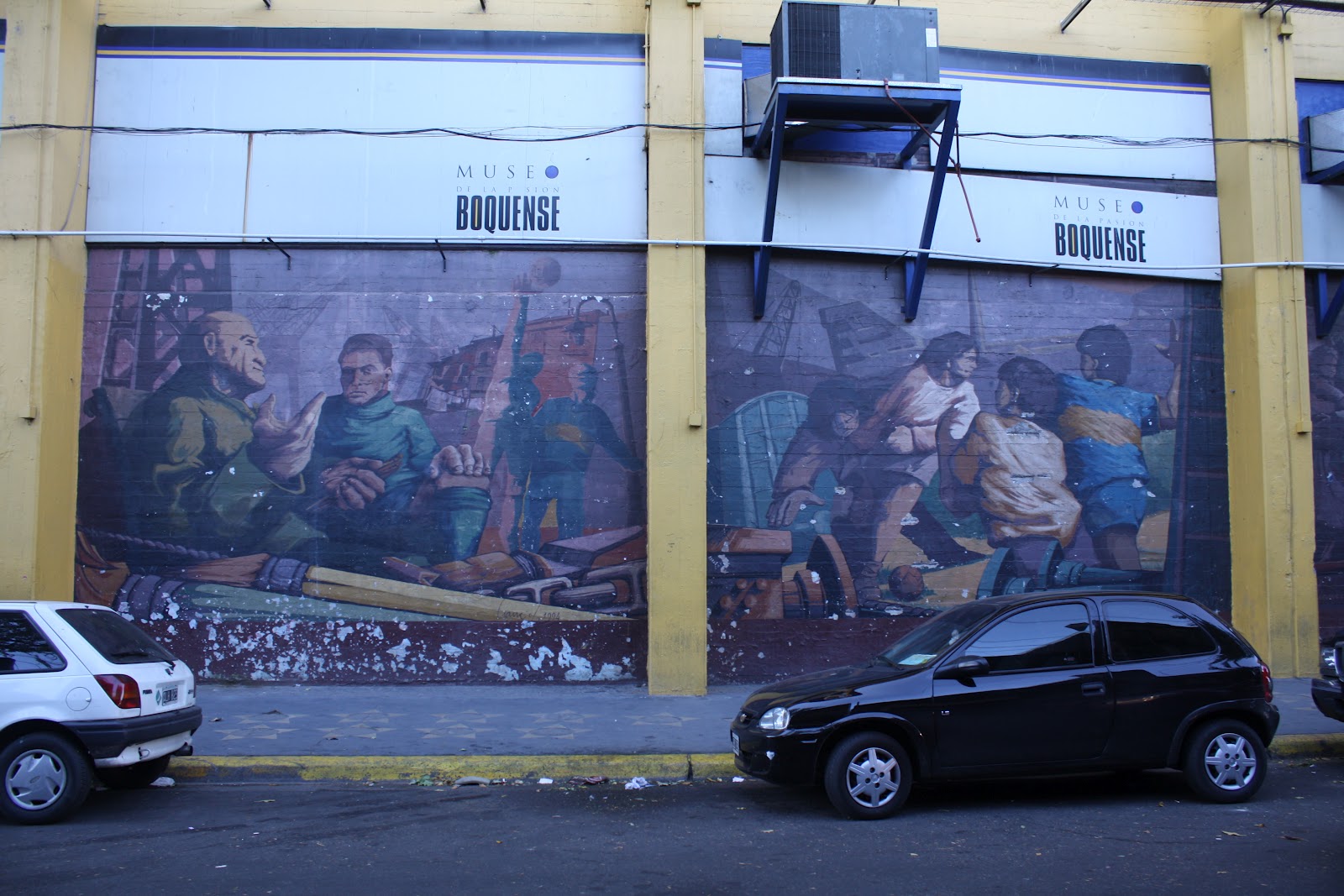
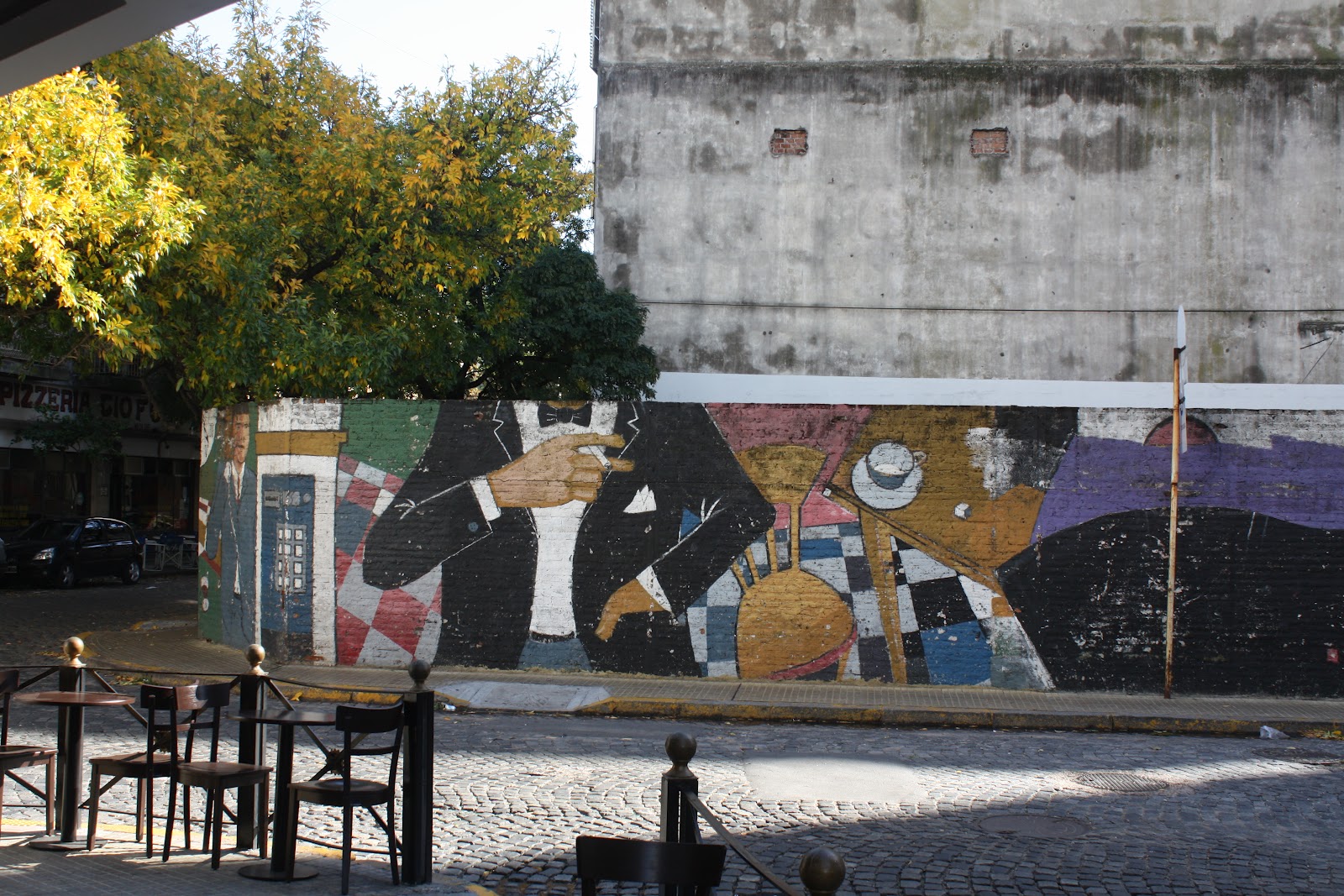
We took a taxi back to Bloomers, hoping to get to another quirky museum a block away for 15 minutes before our cab to the airport was due to arrive; but traffic heading into the center was snarled because streets were blocked off for a celebration of the founding of the city. So I had time to take some photos of the local street art before the cab came and our vacation in Argentina came to a close.
 |
| Street art along Calle Vincente Lopez in Salta |
 |
| Street art along Calle Vincente Lopez in Salta |
 |
| Street art along Calle Vincente Lopez in Salta |
 |
| Street art (with a heavy doze of graffiti) along Calle Vincente Lopez in Salta |
 |
| Street art along Calle Vincente Lopez in Salta |
 |
| Street art along Calle Vincente Lopez in Salta |